Throw Quilt Size: Dimensions in Inches, Source by Source
Common throw quilt sizes run 50 × 60 to 60 × 70 in, but sources differ. Each source's size, throw vs. lap vs. twin, and the backing and binding a throw needs.
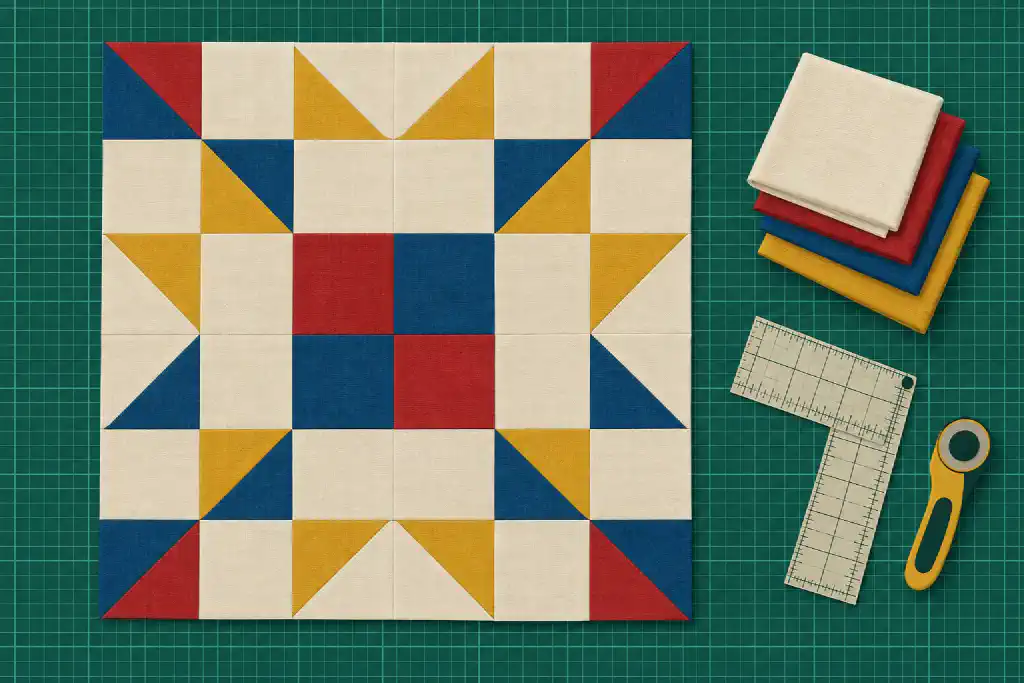
The single size named most often is 50 × 65 in. Missouri Star’s throw guide says a throw of about 50 × 65 in is “the most widely used throw quilt size,” and its chart, Hailey Stitches and Suzy Quilts give that size too. A throw is a quilt for the couch or a chair. The guide notes that “they’re not tied to mattress dimensions,” so sizes vary.
For a 50 × 65 in throw, the backing calculator (fabric for the back of the quilt) gives 3 1/4 yd and the binding calculator (the strips that finish the edges) gives 1/2 yd. Other sizes are in the backing and binding table, and every source’s range is in our quilt size chart.
Throw quilt sizes by source
| Source | Throw size (in) | Note |
|---|---|---|
| Missouri Star chart (retailer) | 50 × 65 | — |
| Missouri Star throw guide (retailer) | 50 × 60 to 60 × 70 | recommends 56 × 70 |
| Linda’s (retailer) | 50 × 60 to 60 × 70 | “Couch, decorative use” |
| Stitchin’ Heaven (quilt shop) | 50 × 60, 60 × 72, 65 × 80 | minimum, typical, generous |
| Hailey Stitches (quilting blog) | 50 × 65 | “any width and length between 50″ – 70″” |
| Lo & Behold Stitchery (pattern designer) | “about 60” on one side” | large throws “up to 70” to 80”” |
| Suzy Quilts (pattern designer) | 50 × 65 | “very approximate” |
Our math: together these make our chart’s throw row, 50–70 in wide and 50–80 in long. Hailey Stitches’ range sets the 70 in width and the 50 in length, and Stitchin’ Heaven’s 65 × 80 sets the 80. Every other source that gives width and length starts at 60 in long or more. Lo & Behold gives one side only, so it counts toward neither.
The row leaves out Missouri Star’s “Smaller throws, around 40” x 60””, which it calls “great for children or as lightweight lap quilts.”
In centimeters, 50 × 60 to 60 × 70 in is 127 × 152 to 152 × 178 cm.
Throw vs. lap vs. twin quilt
A twin quilt adds drop, the overhang at each side and the foot.
| Quilt | Size (in) | Sized to |
|---|---|---|
| Lap | 30–55 × 45–72 (our chart’s row) | sitting (Linda’s) |
| Throw | 50–70 × 50–80 (our chart’s row) | one person on a couch (Linda’s) |
| Twin | 63–70 × 86–90 (our chart’s row) | a 38 × 75 in mattress, plus drop |
FaveQuilts, a craft publisher, says “Generally, throw and lap quilts are the same size and are used for the exact same thing,” but also “Throw quilts are generally bigger than a lap quilt.” Missouri Star’s own pages disagree: its chart gives Lap and Throw the same 50 × 65 in, while its throw guide puts a lap at approximately 40 × 50 in. Our advice: name the use, not the label.
Our math: a 50 × 65 in throw on a 38 × 75 in twin mattress (Sleep Foundation) hangs (50 − 38) ÷ 2 = 6 in at each side and stops 75 − 65 = 10 in short of the foot. Stitchin’ Heaven’s 65 × 80, the largest sourced throw, hangs 13 1/2 in at each side and 5 in at the foot: as wide as a twin quilt but 6–10 in shorter than the chart’s 86–90 in twin length.
For a twin, open the size chart with a 15 in drop (68 × 90 in); the buttons under the result send it to backing and binding.
How to pick a throw size
- Who will use it, and how. American Patchwork & Quilting says to “keep in mind who will be using it. Are they tall adults or small children? Will they want to lay it over their laps or wrap up in it?” For a 6-foot-tall adult, Hailey Stitches says to “make sure the length is at least 72″.”
- Measure, then match the pattern. Our advice: sit where the throw will be used and measure from your shoulder to just past your feet. Missouri Star advises, “When following a pattern, note the finished size listed and consider if adjustments are needed.”
- Make the top bigger than the finished size. American Patchwork & Quilting warns that “The amount of quilting done and the type of batting used can result in a 3%–5% loss in the overall size of the quilt.” Our math: for a 50 × 65 in finished throw, make the quilt top (the pieced front) 51 5/8 × 67 1/8 to 52 3/4 × 68 1/2 in. That is the finished size ÷ 0.97 to ÷ 0.95, rounded up to the next 1/8 in. List the pieces for that larger top in the fabric yardage calculator. Its “Pre-wash shrinkage” field is for fabric that shrinks in the wash; leave it at 0 unless you pre-wash.
Backing and binding for a throw
From our calculators, by finished size. Each link opens the calculator at that size, with every step under “Show the math.”
| Finished throw (in) | Backing | Binding |
|---|---|---|
| 50 × 60 | 3 1/4 yd | 6 strips, 1/2 yd |
| 50 × 65 | 3 1/4 yd | 7 strips, 1/2 yd |
| 56 × 70 | 3 5/8 yd | 7 strips, 1/2 yd |
| 60 × 70 | 3 7/8 yd | 7 strips, 1/2 yd |
| 60 × 72 | 3 7/8 yd | 7 strips, 1/2 yd |
| 65 × 80 | 5 yd | 8 strips, 5/8 yd |
If you made the top bigger (step 3), enter the top’s size in the backing calculator: either end of that range needs 3 3/8 yd. Binding goes on after quilting, so it uses the finished size.
The calculators assume 42 in usable fabric (“measure your fabric selvage to selvage and enter it if it differs”; the selvage is the factory edge), 1/2 in seams, and 2 1/2 in binding strips with 12 in extra. Backing allows 4 in extra per side. Missouri Star says most longarm quilters (who quilt tops on a large frame machine) ask for 4–6 in of extra backing, and at 6 in a 50 × 65 in throw needs 3 1/2 yd.
Common mistakes
- Assuming a “throw” batting size fits a throw. Batting is the middle layer. Stitchin’ Heaven’s batting chart lists a throw-size batting package at 60 × 60 in, for “Small throws and lap quilts,” and says to leave “at least 3 to 4 inches of batting beyond the quilt top on every side.” Our math: a 60 × 60 in package fits a top up to 52–54 in square, while a 50 × 65 in throw needs batting at least 71–73 in long. The batting size chart lists larger packages.
- Treating a chart size as the standard. Lo & Behold says “sizes are not universal, from one designer or book to the next, or even pattern to pattern.” Linda’s adds: “Your project may fall outside these ranges and still be correct.”
- Making a throw for a wheelchair. Linda’s: “A throw-sized quilt is often too large for wheelchair use.” The size chart lists wheelchair quilt sizes.
Picked a size? Use its backing link, then binding, then the fabric yardage calculator for the top. For a bed quilt, see twin, queen and king quilt dimensions or start in the quilt size chart.