Quilt Binding Width: Cut Size, Finished Width and Chart
How wide to cut quilt binding: 2 1/4 or 2 1/2 in. By our reading, both finish about 1/4 in at a 1/4 in seam. Binding width chart for wider bands.
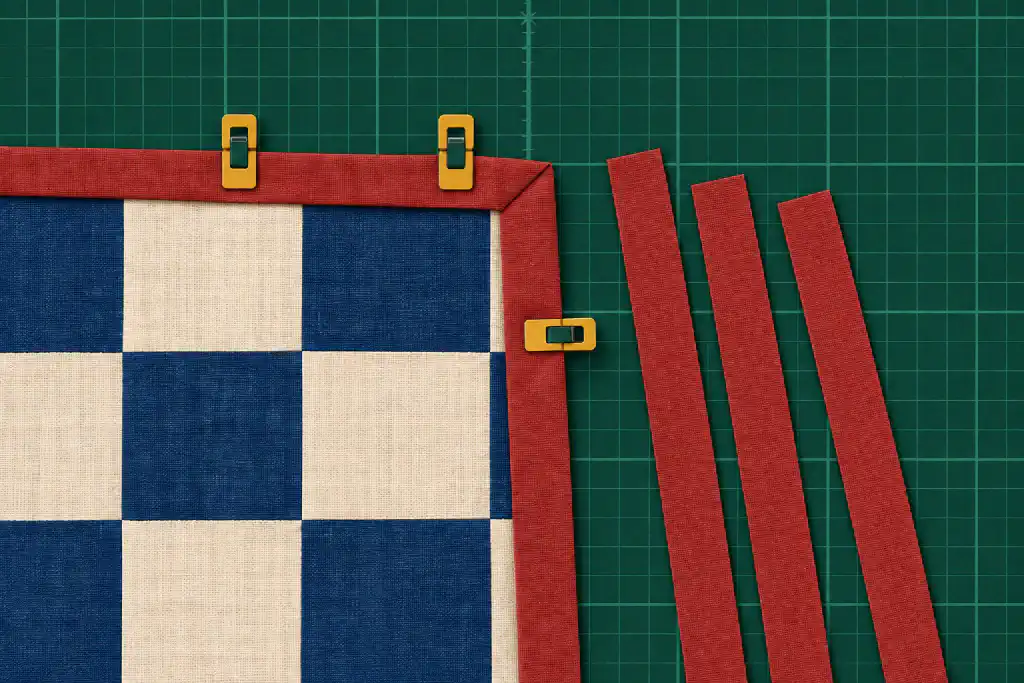
Cut double-fold binding 2 1/4 or 2 1/2 in wide. Those are the widths in three of the tutorials checked here: Utah State University (USU) Extension, Quilting Daily and the retailer Fat Quarter Shop. Binding is the strip folded over the quilt’s raw edges; double-fold means it’s folded in half lengthwise, so two layers wrap the edge. USU picks by batting: 2 1/4 in for thin, 2 1/2 in for thick. All three sew it on with a 1/4 in seam allowance (how far from the raw edge you stitch; “seam” below). By our reading, both widths then finish about 1/4 in wide on the front, and the wider strip’s extra wraps a thicker edge.
If you’re unsure (our advice): cut 2 1/2 in. It’s the calculator’s default, and it leaves more to wrap the edge. Then enter your quilt size in the quilt binding calculator.
Binding width chart
| Seam you sew (= finished band) | Cut width | Batting or note | What sources say |
|---|---|---|---|
| 1/4 in | 2 in | batting trimmed flush | Watson cuts 2 in and reports 1/4 in |
| 1/4 in | 2 1/4 in | thin batting (USU) | USU, Quilting Daily; neither gives a finished width |
| 1/4 in | 2 1/2 in | thick batting (USU) | USU, Fat Quarter Shop; neither gives a finished width |
| 3/8 in | 2 1/2 in | by Singer’s rule | No source checked cuts for a 3/8 in band |
| 1/2 in | 3 1/4 in | by Singer’s rule | No source checked gives this width; APQS’s yardage chart covers 2–4 in strips |
| 5/8 in | 4 in | by Singer’s rule | Singer’s own example |
Rows marked “by Singer’s rule” are our arithmetic (6 × band + 1/4 in); the 1/4 in rows show what the sources cut. Pairing each seam with an equal band is our reading of Singer and Watson (below).
By our reading, the same 2 1/2 in strip makes a 1/4 or 3/8 in band depending on the seam, which may be why charts online disagree about it.
What sets the finished width
Cut width is the flat strip; finished width is the band that shows on the front once the binding is turned and stitched.
Singer’s double-layer binding guide gives a rule: multiply the finished width by six, then add 1/4 in “to compensate for batting and fabric thickness.” In its example, the band and the seam are both 5/8 in, cut from 4 in strips. It’s a sewing-machine maker’s general binding guide, not a quilting standard.
Why six? Singer doesn’t say; this is our reading. The folded strip, half the cut width, has to cover three band widths (the seam allowance under the band, the front band and the back band) plus the edge’s thickness. Doubled to the cut width, that’s six bands; the added 1/4 in stands in for the edge.
Christa Watson, writing on BERNINA’s WeAllSew blog, sews binding at a 1/4 in seam. She cuts 2 in strips so they finish at an even 1/4 in on both sides of the quilt. Singer’s rule gives 1 3/4 in for that band, within 1/4 in of her 2 in. Her advice for wider strips: “If you are sewing wider binding strips, use a slightly wider seam allowance.”
So, by our reading of Singer’s example and Watson’s advice, the seam you sew sets the band, and the strip only has to be wide enough to wrap it. Sew Nikki, a quilting blog, says “Most finished bindings are approximately 1/4-inch wide on the front of the quilt.”
The chart’s widths should hold for bias strips too (cut at 45° to the threads, for curved edges). The sources only cover straight-grain strips (cut along the threads), so this is our inference. For how much fabric bias strips take, see the calculator’s bias section.
Thin or thick batting: 2 1/4 or 2 1/2 in?
Loft is the batting’s thickness, or puffiness. Even one maker’s range is wide: Hobbs lists an approximate loft of 1/8 in for its Tuscany 100% cotton and 5/8 in for its CloudLoft polyester. A quilted, stitched edge is likely thinner than the listed loft (our reasoning). None of the sources checked gives a strip width for high-loft batting, beyond USU’s 2 1/2 in for thick batting and Singer’s added 1/4 in for batting and fabric thickness.
Our advice: each extra 1/8 in of edge thickness takes about 1/4 in more cut width, because both layers of the folded strip wrap the edge.
Some tutorials leave batting past the edge of the quilt top; that isn’t a reason to go wider. Quilting Daily leaves about 1/4 in of batting beyond the top “to fill binding uniformly” and still cuts 2 1/4 in. Fat Quarter Shop also leaves 1/4 in; USU and Watson trim it off first.
Before you cut the rest, fold a scrap strip around a corner of your quilt sandwich (top, batting and backing).
Wider or narrower binding
For a wider band, widen the seam and the strip together, using the chart row.
Wider strips use more fabric. Say your quilt is 60 × 72 in. The calculator assumes 42 in of usable fabric width, the width left once the selvages (factory edges) are trimmed; USU counts 40 in, so 42 is the high end. On that quilt at 42 in, 3 in strips take 3/4 yd instead of 1/2 yd at 2 1/2 in. Check the 60 × 72 example at 2 1/2 in or at 3 in; each link replaces your inputs.
On thin, flush-trimmed batting, you can start from the chart’s 2 in row, as Watson does. Sew Nikki disagrees: 2 in left her “less wiggle room,” and she calls 2 1/2 in “really the best choice for all your quilted projects.” At a 1/4 in seam it’s still a 1/4 in band; a narrower band needs a narrower seam as well. Whatever width you cut, check with USU’s test: “The folded edge should lay just past the binding stitching.”
Cutting to width and sewing the seam
Cut the strips at the chart width. With a rotary cutter, OLFA says: “Cut away from yourself, never toward yourself.” It also says to close the cutter each time you finish a cut.
Fold each strip in half lengthwise, wrong sides together, and press, as USU, Quilting Daily and Fat Quarter Shop do (Singer says not to). At the iron, one iron maker’s manual, for Rowenta’s Smart Steam, warns: “Burns can occur from touching hot metal parts, hot water, or steam.” Then sew at the chart row’s seam.
Common mistakes
- Cutting a wider strip but keeping the 1/4 in seam, and expecting a wider band (see “What sets the finished width”).
- Going by the package loft without folding a test scrap (see “Thin or thick batting”).
Next: how much binding fabric
Enter your width in the quilt binding calculator. It shows the math and rounds fabric up to the next 1/8 yd.
Is the binding fabric also in your top or border? For straight-grain strips, the calculator’s Add these strips to the fabric yardage calculator button carries them to the fabric yardage calculator, so you can buy one cut. Bias binding doesn’t carry over.
Not there yet? Try the quilt size chart or the quilt backing calculator.