How Many Fat Quarters in a Yard? Four, and When It Isn't Enough
Four fat quarters make one yard, by area. See the math, a yards-to-fat-quarters chart, and the cut sizes where four fat quarters give fewer pieces than a yard.
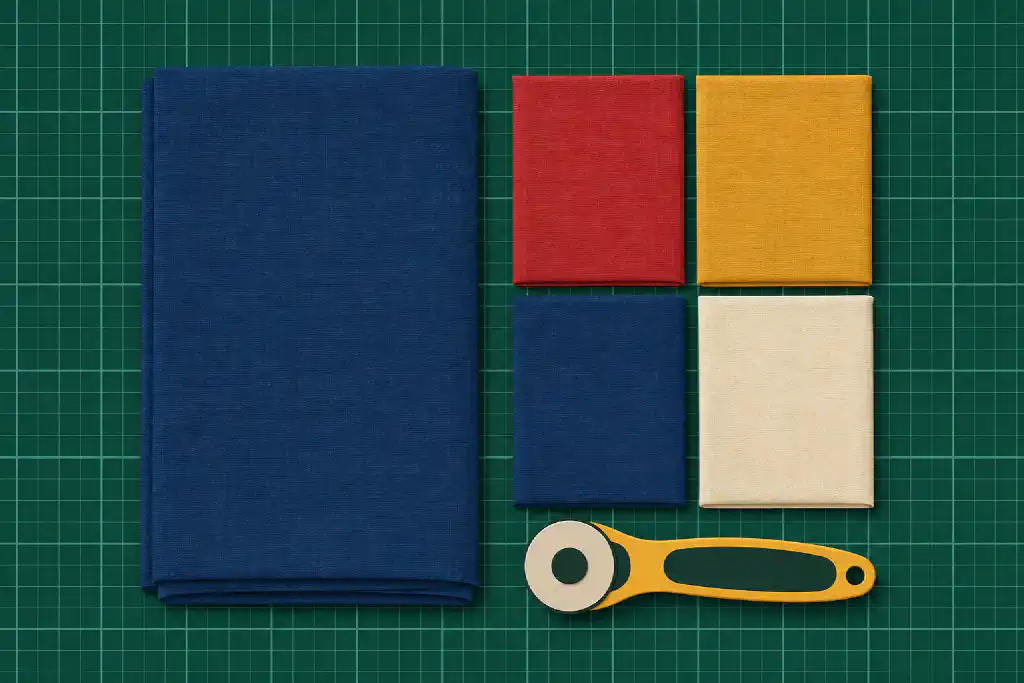
There are 4 fat quarters in a yard. A yard is 36 in long. At the 42 in usable width our calculators assume, cut it in half both ways: 36 ÷ 2 = 18 and 42 ÷ 2 = 21, so 4 pieces of 18 × 21 in. A fat quarter is a quarter yard cut as a squarish 18 × 21 in piece instead of a 9 in strip across the full width. Fat Quarter Shop, a quilt retailer, defines it as “A frequently used piece of fabric measuring 18” x 21"."
The fabric yardage calculator turns your pattern’s cut sizes into yards to buy; the steps below turn yards into fat quarters. Four holds by area, but not always piece for piece.
One yard, cut in half both ways
Pintuck & Purl, a New Hampshire quilt shop, describes the cut: a fat quarter “begins as a half-yard, which is 18” off the bolt. That half-yard is then cut in half at the fold from the other direction.”
The areas match: 36 × 42 = 1,512 sq in, and 4 fat quarters of 18 × 21 = 378 sq in make 1,512.
The width is the assumption. WOF (width of fabric) runs selvage to selvage; the selvage is the factory edge, which the quilting blog Polka Dot Chair says is “usually removed during cutting.” We assume 42 in: 44 to 45 in quilting cotton, less the selvages and some shrinkage. That’s this site’s default, not a published standard.
Shop fat quarters run 18 × 21 to 22 in; the fat quarter size guide explains why. C&T’s backing guide (2009) assumes a 40 in WOF, and at 40 in a yard cut in four gives 18 × 20 in pieces.
Our advice: measure your fabric between the selvages. Below 42 in, a yard cut into four gives fat quarters shorter than 21 in on the long side (half your measured width), so check your largest piece against that.
Yards and fat quarters: a conversion chart
By area, each yard is 4 fat quarters (yards × 4); piece counts can push the number you need to buy higher, as below.
| Yardage | Fat quarters (by area) |
|---|---|
| 1/4 yd | 1 |
| 1/2 yd | 2 |
| 3/4 yd | 3 |
| 1 yd | 4 |
| 1 1/2 yd | 6 |
| 2 yd | 8 |
| 3 yd | 12 |
A half yard is 18 in × WOF, so 2 fat quarters equal one half yard by area. A quarter yard is 9 in × WOF (36 ÷ 4): the same area as a fat quarter, but Pintuck & Purl calls it “a strip about 9” x 42–44””, so no piece from it can be taller than 9 in.
5/8 yd is 2 1/2 fat quarters by area, so at least 3; count your pieces first, as in the section on yardage patterns.
From a fat-quarter pattern to yardage
A fat-quarter pattern lists its fabric in fat quarters. Divide by 4: 12 fat quarters of one print are 3 yd by area. That’s the most yardage you’d need.
By our reasoning, that ceiling holds only if the pattern’s largest piece fits 18 × 21 in and your fabric is at least 42 in between the selvages. Pintuck & Purl gives fat quarters as “about 18” x 21–22””, so a pattern may plan pieces to 22 in, which a 42 in yard cut in four can’t give.
For the real figure, often less, enter the cut sizes in the fabric yardage calculator; the yield table below shows why. Say a pattern cuts 24 squares at 6 1/2 in from 4 fat quarters, 6 from each. Cut from yardage, they need only 3/4 yd (load this example), even from 40 in fabric (load it at 40 in).
Pintuck & Purl says the Regent Park pattern “calls for 13 fat quarters plus 5/8 yard for binding”. That’s 3 1/4 yd by area, but only if all 13 are one print. A long fat-quarter list often means many prints, so read the fabric list before adding it up.
Binding, the strip that wraps the quilt’s edge, is why that pattern lists yardage too. “If the pattern asks you to cut strips the full width of the fabric (for borders, sashing, or binding, for example), you’ll want regular yardage for those pieces,” Pintuck & Purl says. A strip cut from a fat quarter is about 21 in long, half a WOF strip, so you need about twice as many strips and joins (the seams that link strips into one length). The binding calculator set to a fat quarter’s 21 in side shows it for a 60 × 72 in quilt: 15 strips, against 7 at 42 in.
From a yardage pattern to fat quarters: when four isn’t enough
Pintuck & Purl and Mrs Quilty, two quilt shop blogs, both say 4 fat quarters per yard. Mrs Quilty extends it: “If a pattern calls for 2 yards, you’ll need 8 fat quarters.”
Even when every piece fits, four fat quarters can give fewer pieces than a yard. By our reasoning, a yard’s strips run the full 42 in, while a fat quarter’s leftovers stop at its edges. Squares cut from 4 fat quarters (4 × the per-fat-quarter counts in the fat quarter size guide) against 1 yard, from the math behind this site’s calculators, at 42 in with no shrinkage:
| Cut square | 4 fat quarters | 1 yard |
|---|---|---|
| 2 1/2 in | 224 | 224 |
| 4 1/2 in | 64 | 72 |
| 5 in | 48 | 56 |
| 6 1/2 in | 24 | 30 |
| 10 in | 8 | 12 |
With the same math, 18 × 22 in fat quarters give the same counts for all five sizes.
At 5 in, 24 squares convert cleanly: 1/2 yd (load this example) or 2 fat quarters at 12 each. At 10 in, 8 squares don’t: 5/8 yd (load this example), but 4 fat quarters at 2 each, a full yard by area.
Turning it into fat quarters to buy
- Pieces per fat quarter: the fat quarter size guide shows how to count them.
- Fat quarters to buy = pieces needed ÷ pieces per fat quarter, rounded up. For the 10 in squares, 8 ÷ 2 = 4.
- Selvage: plan on 18 × 21 in, our calculators’ cautious default, and measure after trimming; see the guide’s tight rows.
- Strips: 18 ÷ 2 1/2 gives 7 binding strips per fat quarter, so the 15 above take 3.
Common mistakes
- Multiplying a pattern’s yardage by 4 for big pieces. The 10 in squares need 4 fat quarters, not the 2 1/2 that 5/8 yd suggests.
- Dividing a fat-quarter count by 4 for the yardage to buy. The calculator often gives less, as the 6 1/2 in squares show.
- Cutting binding or borders from fat quarters without counting about twice the strips and joins.
- Cutting your own fat quarters from fabric under 42 in and expecting 18 × 21 in.
Related
- Fabric yardage calculator: yards to buy, rounded up to the next 1/8 yd.
- Fat quarter size guide: pieces per fat quarter, to finish the hand count.
- Quilt binding calculator: strips and yardage, including at a fat quarter’s 21 in.