Fat Quarter Size: 18 × 21 to 22 in, and What You Can Cut
Fat quarter size is 18 × 21 to 18 × 22 in. How many squares and strips fat quarters cut, with the math shown, plus fat eighth size and the quarter yard.
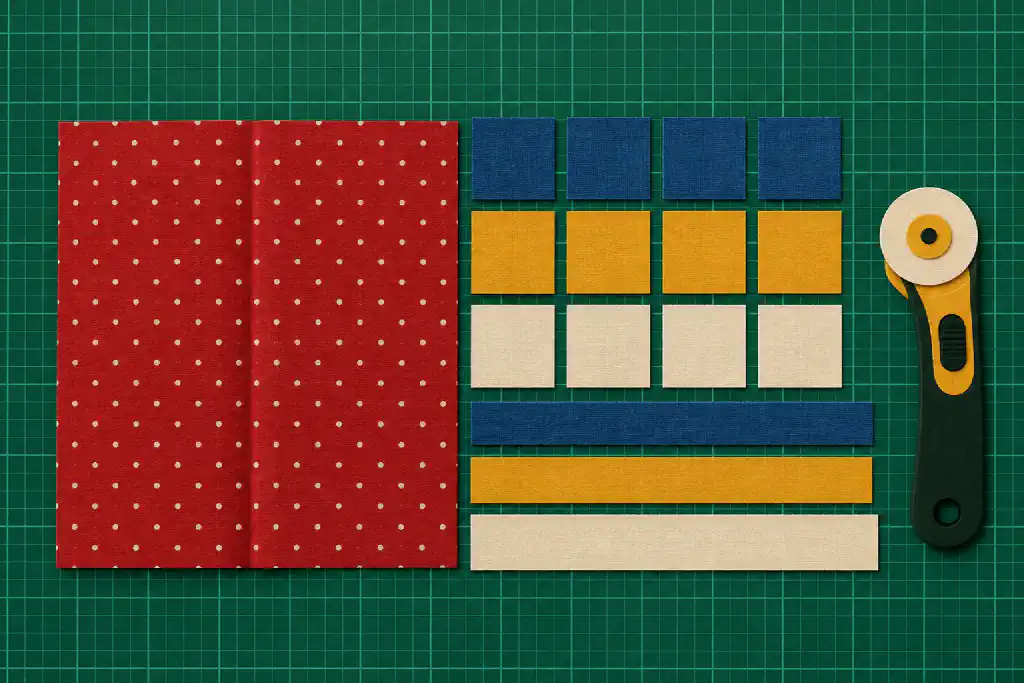
A fat quarter measures 18 × 21 in to 18 × 22 in (45.7 × 53.3 cm to 45.7 × 55.9 cm, our conversion). It’s a precut (fabric a shop sells already cut to a standard size) holding a quarter yard, cut squarish instead of as a long strip. The retailer Fat Quarter Shop and The Quilt Show’s Quiltipedia give 18 × 21 in; the retailers Missouri Star and Stitchin’ Heaven give 18 × 22 in.
Got a cut list? The fabric yardage calculator shows what it takes off the bolt, so you can compare it with buying fat quarters (twelve 5 in squares: 3/8 yd).
Why a fat quarter is 18 × 21 or 18 × 22 in
Stitchin’ Heaven, a quilt shop, describes the cut: a half yard, “18 inches across the full width,” and then the shop “cuts that piece in half along the fold.” So one side is half of a 36 in yard, and the other is half the WOF (width of fabric, selvage to selvage; selvages are the factory edges). A fat quarter can keep a selvage at one end of that side, which we infer from the cut (tight rows).
Halve 44 in fabric and you get 22 in. Fat Quarter Shop sells fabric “44″ wide unless stated otherwise” and lists its fat quarters at 18 × 21 in; it doesn’t say why. Speaking generally, Stitchin’ Heaven says an 18 × 21 listing “usually means the fabric came off a narrower bolt.”
The UK shop Pelenna Patchworks says patchwork fabric there is usually sold off a 110 cm bolt, and defines a fat quarter as half a meter cut in half, “approximately 50cm x 55cm (20″ x 22″).” We read a 20 × 22 in “fat quarter” as a metric cut.
Our advice: plan on 18 × 21 in, our calculators’ cautious default (see before you cut).
How many squares you can cut from a fat quarter
Round each side down, then multiply: for 5 in squares, 18 ÷ 5 = 3.6, so 3 fit across the 18 in side; 21 ÷ 5 = 4.2, so 4 fit down the 21 in side; 3 × 4 = 12.
| Cut square | Across × down | Squares | Spare across (in) | Spare down (in) |
|---|---|---|---|---|
| 2 1/2 in (mini charm) | 7 × 8 | 56 | 1/2 | 1 |
| 3 in | 6 × 7 | 42 | 0 | 0 |
| 3 1/2 in | 5 × 6 | 30 | 1/2 | 0 |
| 4 1/2 in | 4 × 4 | 16 | 0 | 3 |
| 5 in (charm) | 3 × 4 | 12 | 3 | 1 |
| 6 1/2 in | 2 × 3 | 6 | 5 | 1 1/2 |
| 8 1/2 in | 2 × 2 | 4 | 1 | 4 |
| 10 in (layer cake) | 1 × 2 | 2 | 8 | 1 |
| 12 1/2 in | 1 × 1 | 1 | 5 1/2 | 8 1/2 |
Sizes are cut sizes, with seam allowance included. The counts are our arithmetic on 18 × 21 in; precut names follow Fat Quarter Shop (mini charm, charm) and Stitchin’ Heaven (layer cake). On 18 × 22 in every row comes out the same. Missouri Star says “up to (6) 5″ charm squares”; a plain grid fits 12, and the page doesn’t say what it allowed for.
Tight rows: when a side comes up short
A side loses a row once it comes up short by more than its spare. Trimming a selvage end shortens only the 21 in side; squaring up and pre-wash shrinkage can shorten either side. Counting the grid again:
- 21 in side at 20 1/2 in: 3 in squares drop from 42 to 36, and 3 1/2 in squares from 30 to 25.
- 18 in side at 17 1/2 in: 3 in squares drop from 42 to 35, and 4 1/2 in squares from 16 to 12.
- Both sides: Stitchin’ Heaven says pre-washing shrinks a fat quarter “by a half inch or so in each direction.” At about 17 1/2 × 20 1/2 in, that’s 30 squares at 3 in, 25 at 3 1/2 in and 12 at 4 1/2 in; the other rows hold.
Need more than one fat quarter holds? See buying yardage instead.
Strips from a fat quarter
Along the 21 in side, 18 ÷ 2.5 = 7.2, so you get 7 strips 2 1/2 × 21 in. The other way, 21 ÷ 2.5 = 8.4 gives 8 strips 18 in long. We infer the 21 in strips run crosswise (selvage to selvage), like half-length WOF strips. For binding, see how much binding a fat quarter makes.
Before you cut a fat quarter
- Measure it. Missouri Star says variations “can happen due to pre-washing or uneven cutting at the store.”
- Cut safely. Rotary-cutter maker OLFA says: “Cut away from yourself, never toward yourself.” Keep your hand on the ruler “with fingers away from the edge.” And: “Automatically close the cutter when you complete a cut.”
- If one end still has its selvage, trim it off (see why).
- Square up one edge. Stitchin’ Heaven says fat-quarter edges “are often slightly off,” and advises: “Trim one straight edge with a ruler and rotary cutter before you start measuring blocks.” Measure again; if a side is short, check the tight rows.
Fat quarter vs. quarter yard (and the “long quarter”)
A regular quarter yard “would be cut 9″ x 42″ or the Width of Fabric (WOF),” says Quiltipedia. Fat Quarter Shop calls a fat quarter “a quarter-yard of fabric cut into a rectangle”: the same amount, a different shape. The UK retailer Sewing Street calls a cut of about 9 × 44 in a “long quarter.”
The shape changes the count (a 9 × 42 in quarter yard vs. an 18 × 21 in fat quarter, by our count):
- 5 in squares: 8 vs. 12.
- 4 1/2 in squares: 18 vs. 16, so the quarter yard wins.
- 10 in squares: 0 vs. 2, because a 9 in strip can’t fit one.
Buying yardage instead of a fat quarter
The yardage calculator cuts strips across the WOF and rounds up to the next 1/8 yd, so a fat quarter’s cut list can take more than 1/4 yd off the bolt:
- 12 squares at 5 in: 2 strips × 5 in = 10 in, so 3/8 yd (load this example).
- 20 squares at 5 in: two fat quarters, or 3 strips × 5 in = 15 in, so 1/2 yd (load this example).
Stitchin’ Heaven notes: “Four fat quarters still add up to a full yard.” See how many fat quarters are in a yard.
Fat eighth size
Fat Quarter Shop says “Fat Eighths measure 9″ x 21″.” Stitchin’ Heaven and Sewing Street give about 9 × 22 in. The quilting blog Patchwork Posse lists two cuts, “9″ x 22″” or “18″ X 11″,” and says to “read the fine print.”
The shape matters: a 9 × 21 or 9 × 22 in piece gives four 5 in squares (1 × 4), and an 18 × 11 in piece gives six (3 × 2). For 10 in squares, it’s none against one.
Our advice: if a pattern counts on fat eighths, check which shape the shop cuts before you buy.
Common mistakes
- Planning a tight layout on 18 × 22 in when yours is shorter after trimming (tight rows).
- Assuming every “fat quarter” listing is 18 × 21 in. In one Amazon search (October 16, 2026), listed sizes included 18 × 21 in, 18 × 22 in, 20 × 20 in and 50 × 50 cm. Check the stated size.
Planning a whole quilt? Try the fabric yardage and quilt binding calculators.