Quilt Batting Size Chart: Package Sizes and What They Cover
Quilt batting sizes, crib to king, from three makers' specs, and why three of four common queen quilt sizes need a king batting or a roll at 4 in per side.
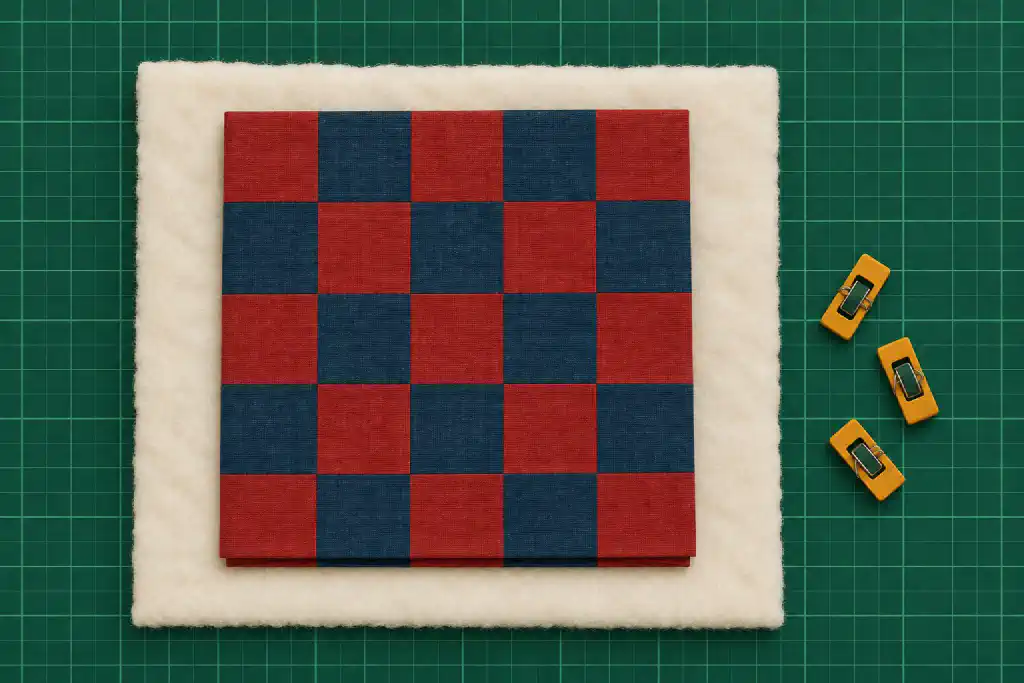
Batting is the middle layer of a quilt, between the pieced top and the backing. The package sizes below are typical and vary by brand, so check the package. Missouri Star says most longarm quilters, who finish quilts on a frame-mounted machine, ask for 4 to 6 in per side, so ask yours. Don’t know your top’s finished size? Start at the quilt size chart.
Quilt batting sizes by package name
We used the three makers whose own pages list package sizes we could verify, one product each. Other makers’ sites we checked listed none, couldn’t be reached, or printed sizes we couldn’t confirm.
| Package | Published sizes (in) | Largest top at 4 in per side (our arithmetic) |
|---|---|---|
| Craft | 34–36 x 45–46 | 26–28 x 37–38 |
| Crib | 45–46 x 60 | 37–38 x 52 |
| Throw | 60 x 60 | 52 x 52 |
| Twin | 72 x 90–96 | 64 x 82–88 |
| Full/double | 81–93 x 96 | 73–85 x 88 |
| Queen | 90–96 x 108 | 82–88 x 100 |
| Superqueen | 93 x 120 | 85 x 112 |
| King | 120 x 120–124 | 112 x 112–116 |
Sources: The Warm Company’s Warm & Natural (craft, crib sold as Baby, twin, full, queen, king; queen page shown; each size is on its own product page), Quilters Dream 80/20 (every size) and Hobbs Poly-Down (crib to king, no craft or superqueen). Per-product sizes and sources are in Typical batting package sizes on the size chart. Quilters Dream prints the longer side first for most of its sizes (“Queen 108” x 93””), so we list its figures shorter side first; the numbers are unchanged.
How much bigger than the quilt top batting should be
This site uses 4 in per side, the same default as the backing calculator.
Missouri Star Quilt Co. writes about backing, not batting: most longarm quilters ask for 4 to 6 in of extra backing all the way around. Its own allowance, 8 in added each way (4 in per side), “covers the fabric that draws up during quilting and gives a longarm machine enough to clamp onto.”
On The Crafty Quilter, Julie Cefalu writes that “in general, it’s suggested” backing and batting be “3 to 4 inches larger on all four sides.” Her longarm figure, 3 to 4 in on each side, is lower than Missouri Star’s. For a home machine she writes, “I suggest an extra 2 to 3 inches.” She sometimes cuts the batting “slightly smaller (1/2” or so)” than the backing to line up the layers.
Our advice: give the batting the same overage as the backing, so one number drives both. If a longarm quilter is finishing the quilt, use their figure for both. None of the three makers’ pages we used says how much larger to cut batting.
Check the package against your top, not the bed name
Size batting from the finished top, not the mattress. Add 8 in to the top’s width and length, then compare with the “Largest top” column or the package, turned either way. The examples are our arithmetic, using our size chart’s quilt sizes.
Queen tops
Say your queen top is 90 x 95 in. It needs 98 x 103. The widest queen package we found is 96 in, so you need a king or batting cut from a roll (see batting by the yard).
Three of the four queen sizes our sources give (Quilting Daily’s and Missouri Star’s 90 x 95, Suzy Quilts’ 90 x 108) need a king or a roll. The fourth, Fat Quarter Shop’s 84 x 92, needs 92 x 100: it fits the 93 and 96 in wide queens but not the 90 in one. Then work out the backing for this 90 x 95 top.
Twin tops
Say your twin top is 70 x 90, the size Quilting Daily and Suzy Quilts give. It needs 78 x 98. Every twin package here is 72 in wide and every full only 96 in long, both short of 78 x 98, so you need a queen, such as Warm & Natural Cotton Batting Queen Size ad , which The Warm Company lists at 90 x 108 in.
Missouri Star’s 68 x 86 twin needs 76 x 94, so a full. Fat Quarter Shop’s 63 x 87 needs 71 x 95; of the twin packages, only Hobbs’ 72 x 96 fits. Next, the backing for a 70 x 90 top. Each bed’s quilt sizes are in twin, queen and king quilt dimensions.
Throw and crib tops
Every specific throw size our sources name needs more than a 60 x 60 throw package. Missouri Star’s smaller throw, around 40 x 60, needs 48 x 68, and its 50 x 65 needs 58 x 73: a twin for each. Stitchin’ Heaven’s generous throw, 65 x 80, needs 73 x 88; the twins are 72 in wide, so a full. Only the small end of Hailey Stitches’ 50–70 in span fits.
Cribs mostly fit. The 36 x 52 crib from Missouri Star and Suzy Quilts needs 44 x 60, and Fat Quarter Shop’s 36 x 36 needs 44 x 44; the crib packages (45–46 x 60) cover both. Quilting Daily’s longer 36 x 60 crib needs 44 x 68, which no crib or throw package covers, so a twin.
Batting by the yard
Batting also comes on wide rolls (bolts) that shops cut to length. Warm & Natural lists 45, 90 and 124 in bolts. Quilters Dream lists its cotton in 18, 60, 93 and 120 in wide rolls. Hobbs lists Poly-Down rolls 108 and 120 in wide.
The rule (our arithmetic, the backing calculator’s one-piece math):
- If the roll is wide enough for the top’s longer side + 8 in, buy the shorter side + 8 in.
- If it’s only wide enough for the shorter side + 8 in, buy the longer side + 8 in.
- If it’s narrower than both, one width won’t cover the top; use a wider roll. None of the three makers’ pages we used gives steps for joining batting.
- Divide by 36 and round up to the next 1/8 yd, or to your shop’s 1/4 or whole yard.
Say you’re cutting batting for your 90 x 95 queen top from a 120 in roll. It needs 98 x 103, and the roll takes the 103 in side across. Buy 98 in: 98 ÷ 36 = 2.72, so round up to 2 3/4 yd. A 90 or 93 in roll is too narrow for either side. A 70 x 90 twin top on a 90 in roll also takes 98 in, or 2 3/4 yd. The backing calculator runs the same one-piece math for the 120 in roll and the 90 in roll. Read its Show the math panel and skip the fabric comparison.
If you trim batting with a rotary cutter, cutter maker OLFA says: “Cut away from yourself, never toward yourself.” And: “Automatically close the cutter when you complete a cut.”
Next: backing and binding
Know your top size? Go to the backing calculator, then the binding calculator. Not yet? The quilt size chart turns your bed into a finished size, and its “Use this size in the backing calculator” and “Use this size in the binding calculator” buttons carry it across.